

Does Homedepot Have The Screw For Dslr Camera?
Fuji Photo Flick has been in the photo business since 1934, only just entered the single lens reflex camera (SLR) marketplace at the commencement of the 70s. At that fourth dimension, Pentax, Minolta, Nikon and Catechism had been selling SLRs for more than 10 years.
Fuji introduced important innovations – the Fujica ST701 was the first SLR using a silicon photo-diode for exposure metering, and in 1974, the ST901 was the first camera to use numerical LEDs to show the selected shutter speed in the viewfinder.
Only Fuji bet on the wrong lens mount – their outset SLR had a "universal" m42 spiral mount that but supported stop downwardly metering at a time when the market place was already demanding full aperture metering. They quickly had to create a proprietary derivative of the "universal" mount to support information technology. Their implementation (a protruding tab on the outside of the aperture ring to transmit discontinuity data to the photographic camera) was clever and maintained the inter-compatibility of the lenses with the cameras of other vendors (I tested Fujinon lenses on Pentax and Yashica cameras – and at that place was no trouble).
In 1979, Fuji was the last major vendor to abandon the screw mount, and finally launched a brand new proprietary bayonet, the "X" mount, supporting all types of machine-exposure modes.
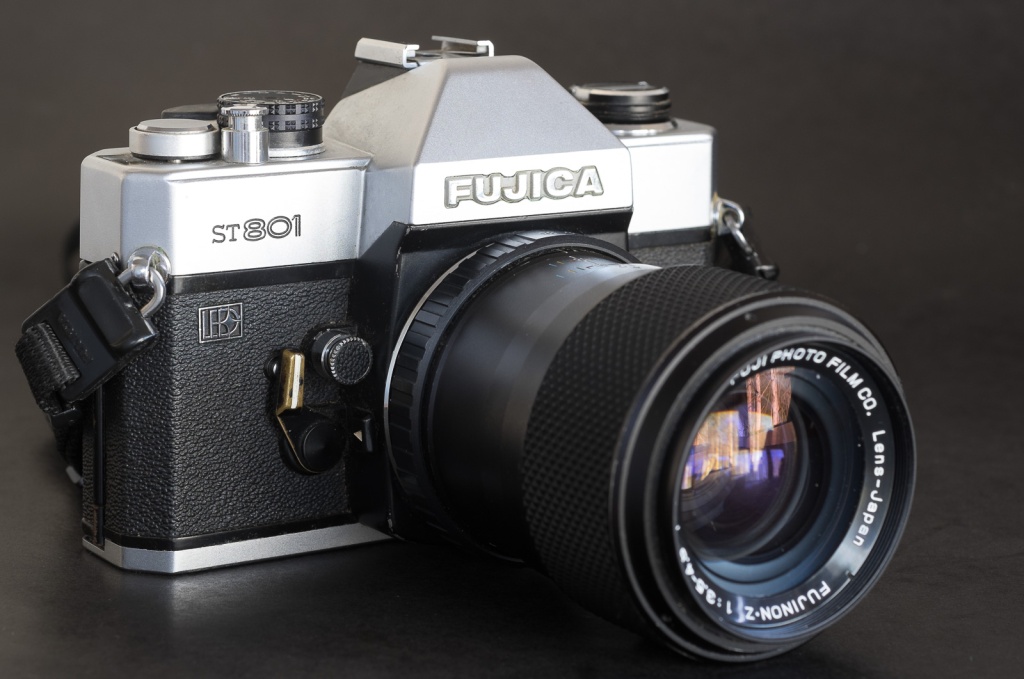
Switching to a new lens mount is always a hard exercise for a camera manufacturer, equally it's a powerful bespeak sent to its installed base of operations that the investment they've made in the lenses of the make is going to be worthless; at some bespeak, the lensman will demand a new camera to replace the existing one, and that day, he/she will too accept to buy a whole new fix of lenses. But if you take to buy everything anew, why stay with the brand that "betrayed" y'all?
The m42 bodies (Fujica ST 701, 705, 801, 901) were technically innovative and were praised by the press, but the bayonet mount cameras (Fujica STX, AX-i, AX-3, AX-5) were nice but unremarkable me-too products that never plant much traction on a marketplace dominated past Canon and Minolta. When Minolta launched the first mod autofocus SLR, the Maxxum 7000, in 1985, Fuji was already folding down its SLR business organisation, and did not even try to launch its ain line of autofocus SLRs. They left the marketplace for good in 1987.
Today, some of the Fujica screw mountain cameras are highly regarded by the supporters of the m42 Universal mount. They were very modernistic when they were launched, and are far more than pleasant to use than cameras of the same generation such every bit the Pentax Spotmatic.
- I would avert all cameras requiring Mercury batteries (ST 701, ST601) as they are not compatible with the silver oxide batteries that almost other cameras of the aforementioned vintage accept (as does the Pentax Spotmatic, for instance).
- The ST901 is an interesting marvel (the first camera with a numeric LED display in the viewfinder), but it'southward one.0 implementation of the feature and the photographic camera only has an discontinuity priority car exposure manner (no semi-automobile exposure control).
- The AZ-one is a derivative of the ST901, without the numeric display in the viewfinder, and was the first SLR from a major vendor to exist equipped with a zoom equally its standard lens. But information technology does not found a reason to buy an AZ-i now, equally information technology offers very little command of the exposure parameters to the photographer (the exposure metering only works in the automatic exposure manner – in that location is no semi-automatic way, it's automatic or fully manual).
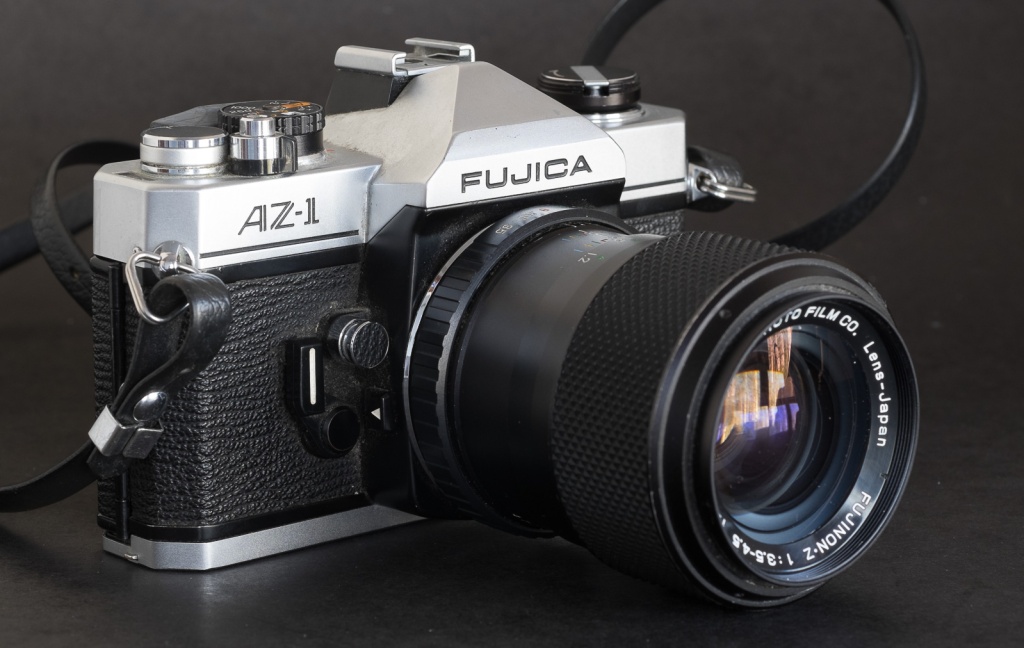 Fujica AZ-1 and Fujinon-X f/iii.5-4.five 43mm-75mm zoom – the AZ-ane was the first mass market SLR bundled with a zoom instead of the standard 50mm lens.
It leaves us with the ST801 and ST705 (both semi-auto cameras with full aperture metering), and the ST605 (an entry level semi-auto camera with stopped down metering and a slower shutter).
- the ST 801 boasts a silicon diode jail cell for metering, LEDs in the viewfinder, silverish oxide batteries, i/2000 shutter, and a very brilliant viewfinder. Information technology was produced from 1972 to 1978. It's still perfectly usable today and tin be establish at reasonable prices (less than $fifty.00) if yous are patient and wait for a good opportunity.
- The ST605 is really abundant and cheap ($10 to $30), simply is very limited (wearisome shutter and stopped down metering). The ST705, which looks like a good compromise on paper, was only produced for 2 years, simply earlier the launch of the Fujica Ten mount cameras. As a result, it's much more than difficult to find.
Fujinon lenses have an excellent reputation in the earth of m42 lenses and apart from the fifty or 55mm lenses which are abundant, they are pretty rare. As the result, they're probably the nigh expensive m42 spiral mountain lenses you can find on eBay. In particular, they are significantly more expensive than equivalent (and similarly highly rated) Pentax spiral mountain lenses.
Tamron used to sell an Adaptall 2 band specifically designed for Fujica's full aperture metering system. Tamron Adaptall lenses are more abundant than Fujica's, and are an interesting option if you don't desire to spend $500.00 on a Fujica EBC Wide Bending lens (for case).
ST 801
The ST801 was the top of the line of Fujica in the seventies – it was significantly more expensive (maybe 25% more) than the Pentax Spotmatic F – which would accept been its closest competitor in the word of spiral mount cameras, and was probably in the aforementioned price subclass as Nikon'south Nikkormat.
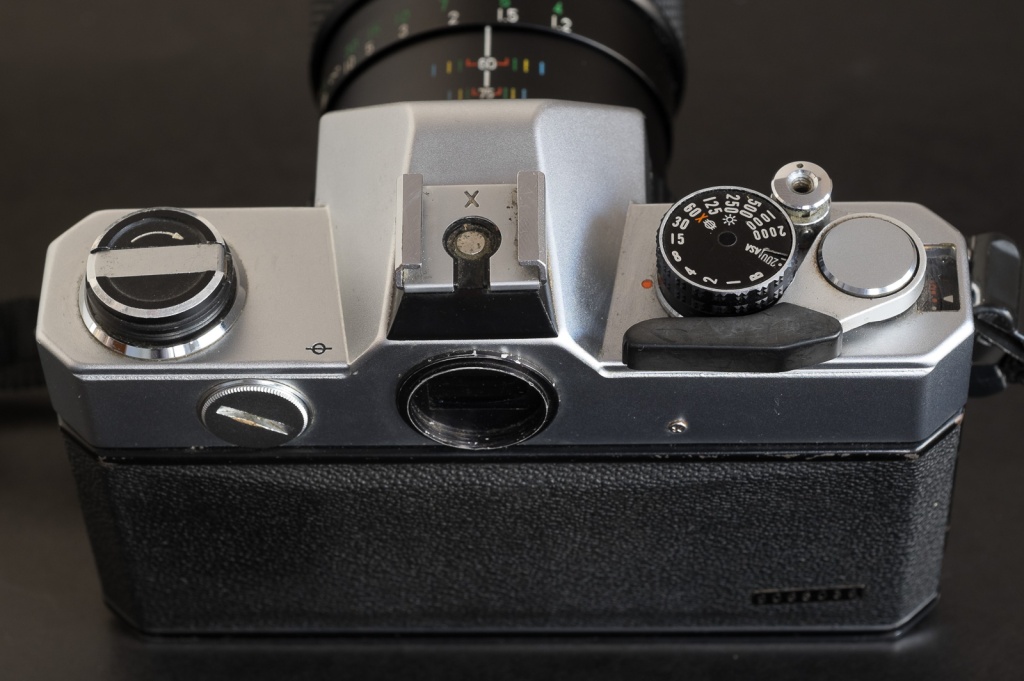
- The ST801 had a long career (1972-1978) and no real successor in the Fujica line up. The Fujica AX cameras that followed benefited from multiple automatic exposure modes and could be fitted with a winder, but their shutters and viewfinders were not as skillful as the ST801's.
- Its modern metering system was distinguishing the ST801 from its competitors (silicon metering cell, LEDs in the viewfinder – no fragile galvanometer- , Silver Oxide batteries). The ST801 aged well in that regard.
- It's a very pleasant camera to utilise – the viewfinder is very bright and clear, the eye relief is OK for a camera launched in 1972. Information technology's like shooting fish in a barrel to compose and focus, the commands are few and logical, and the camera is relatively modest and light.
- It works at total aperture with Fujinon lenses. Full discontinuity metering really makes a difference in ease of utilize. If possible, buy Fujinon lenses, or if you can't notice them, Tamron Adaptall lenses with the specific Fujica mount.
- It meters stopped down with non-Fuji 42mm screw mount lenses. It'due south a bit acrobatics as usual – press simultaneously Depth of Field lever to stop down the lens and the shutter release half style for metering – it works just there is an issue: when the DOF lever is pressed, the shutter release becomes over-sensitive and it's very easy to take a moving-picture show inadvertently while trying to do a metering.
- No motor drive – not an issue today but could accept been in the mid seventies.
- It has a reputation for being a "delicate" camera – I don't know if it'southward justified – Olympus OM-1 cameras were also shunned by printing photographers because they were "fragile". Information technology could take been a reaction from people used to the big and heavy Nikon cameras of that time – and then solid that you could (supposedly) use them to drive nails in a wall.
Conclusion – for a camera of the early on 70'south, the Fujica ST801 is much more than usable than equivalent models from Nikon or Canon. The viewfinder is brighter, the metering arrangement is modern and reactive, and the torso is comparatively smaller and lighter. The dissimilarity with the Pentax models of the aforementioned era (Spotmatic) is too hitting. Peradventure it's because of the sorry country of almost of the copies of the Spotmatic you lot tin can notice today, simply a Pentax feels really clunky compared to the ST801. The Fujica is much more satisfying to use.
In my stance, the ST801 is the best screw mount Fujica photographic camera, and arguably the all-time 42mm spiral mount semi-automatic photographic camera to achieve the mass market place. Ever.

Source: https://cameragx.com/2017/03/01/the-fujica-x-film-cameras/
Posted by: mendosapold1939.blogspot.com
0 Response to "Does Homedepot Have The Screw For Dslr Camera?"
Post a Comment