

How To Get An Author Platform By Blogging
- Make great books.Dedicate yourself to your writing and publishing tasks with the intention of continuous improvement
- Show your work. Show people your great books and also the author behind them–how you write and publish, your inspirations and motivations. Show what you sense your readers want and need from you and your books.
- Generate interest among influencers. This last one is where most authors fall off. Just showing your work or running a great social media account is not enough. You have to channel your books to the right readers so that they become discoverable.
That, in a nutshell, is what a good publisher does.
Book Branding and Author Platform
Branding and building an author platform is relatively simple if you write one kind of book, and particularly if you write in a distinctive niche. But so many authors write and publish a variety of books, across genres, categories and niches.
How can we create a coherent author platform when we write different kinds of books?
Multi-genre Authors: Multiple Platforms
If you have the time, energy, and can afford a virtual assistant, it may be easiest to create more than one platform, with different pen names for each category. Each platform is set up around a different author identity, eradicating any potential confusion with readers, and enabling a smooth transition through marketing funnels and subsequent newsletters and representation to influencers.
However, the more pen names you have, the more time-intensive and complex your marketing becomes. You need separate mailing lists, separate social media accounts, and platform-specific content for each pen name. You run segmented mailing lists which each have a different author persona.
Pros — clear messaging, easy to get themed content to readers, simple and relevant funnel that is easily advertised.
Cons — time-consuming, complicated backend systems to manage multiple accounts.
If you choose this route, your author platforms are primarily strengthened by book promotion–free first in series book, digital advertising, promotional pricing, discounts and deals.
An alternative option is to keep all your books on one author platform, but to separate them using initials or pen names. For example, Joe Bloggs and Joe F. Bloggs. This would keep the metadata and sales data clean on bookselling platforms. It would also mean readers see the correct genre of books in the also-bought categories on sales platforms. The bonus for you is, you only have one platform, one website, one set of social media accounts.
Pros — simpler for the author, less time consuming, simpler backend systems.
Cons — potential for confusing reader messages, potential to lose readers if they get the wrong information/ targeting because you're sending out content for different genres on the same accounts.
However you decide to set up your platform, you'll need to create content for your readers. Whether it's short Facebook posts, longer form blogs, podcasts or perhaps graphical images, you'll need content.
Multi-genre Authors: Single Platform
Perhaps you balk at that challenge, or feel you don't have time for this complexity, or you feel all your books, regardless of genre, are unified by theme or treatment and you want to include them under one platform. Then you need to build your author platform through author, rather than book, promotion.
Spend less time promoting individual books or service you provide, and more on giving interviews, setting up events, getting your name out among influencers, building name recognition and reputation.
You need to think about how your readers will receive your messages. If you write both nonfiction for authors and fantasy books, and you're pushing out content for both these on your Facebook page, your fantasy readers might become disengaged if they constantly see writing advice and vice a versa.
You'll still have to do some element of separation. For example, Orna Ross uses Instagram to build her poetry platform and Facebook to build her fiction and non-fiction platforms. She also separates her literary work from her non-fiction by using an initial in her name. Her fiction and poetry is published under Orna Ross, her non-fiction publishing guides for authors under Orna A Ross.
This keeps her metadata and sales data clean on bookselling platforms and means readers see the correct genre of books in the also-bought categories, while not losing out on the brand recognition of her name.
Pros — less time-consuming, simpler backend systems, brand recognition across books and genres.
Cons — anything that makes readers stop and wonder can divert from engagement.
Author Platform: An Integrated Web Presence

Novelist and ALli member Chrissey Harrison
Our thanks to Chrissey Harrison, novelist and ALLi member, for providing her guide to honing your web presence as part of your author platform, below. While writing her debut novel, Chrissey put much time into creating an effective author platform, so that when it came to publication time, she was able to leverage that platform into fully funding her costs, through a crowdfunding campaign on Kickstarter. You can connect with Chrissey through her author website and on Twitter .
Chrissy has leveraged social media engagement, an email list and Kickstarter's crowdfunding website into a platform that allowed her to earn money while she promoted her book.
"…Support has come from friends and family, [and] although Mime is my debut novel, I have been publishing short stories for some time. As such I've been able to build a mailing list and social media following using my shorter works (and through lots of engagement)… [Also, the unique and often untapped potential of Kickstarter is that it comes with its own audience. A good third of the backers have found the project through Kickstarter – search, mailing lists and notifications – and it is this audience that has accounted for some of the biggest pledges."
Your Web Presence is the sum of everything on the internet that is about you and the goal of your web presence is engagement. You want readers who find you on the web to:
- Buy your books
- Stay in touch (by giving you their email address, ideally, or a social media follow)
- Encourage other people to engage (by sharing content or leaving reviews, ratings and comments)
As an author seeking to grow a platform, your mission is to create an interconnected web presence and remove invisible barriersthat lead to frustration, loss of interest, mistrust and ultimately navigation away.
There are some fundamental principles borrowed from web design, the way public spaces are laid out, and game theory. I call these three principles:
- Entry points
- Intuitive navigation
- Consistent communication
Put briefly, you need ways in (entry points) to your web presence.
Once a reader has entered they need to be able to navigate, quickly (intuitive navigation) and confidently (consistent communication) to other parts of your web presence to satisfy their requirements and, thereby, your goal of engagement.
-
Entry Points
An entry point is anywhere a reader can encounter you. Take note of all the entry points where a reader might encounter you or your books.
- Your book pages on Amazon
- A Google search that leads to an article on your website
- One of your tweets
- An in-person event where you give out a flyer
The more entry points you have, the broader your platform's reach. You will encounter a different population of potential readers on Facebook than you would on other platforms or at a book fair, for example.
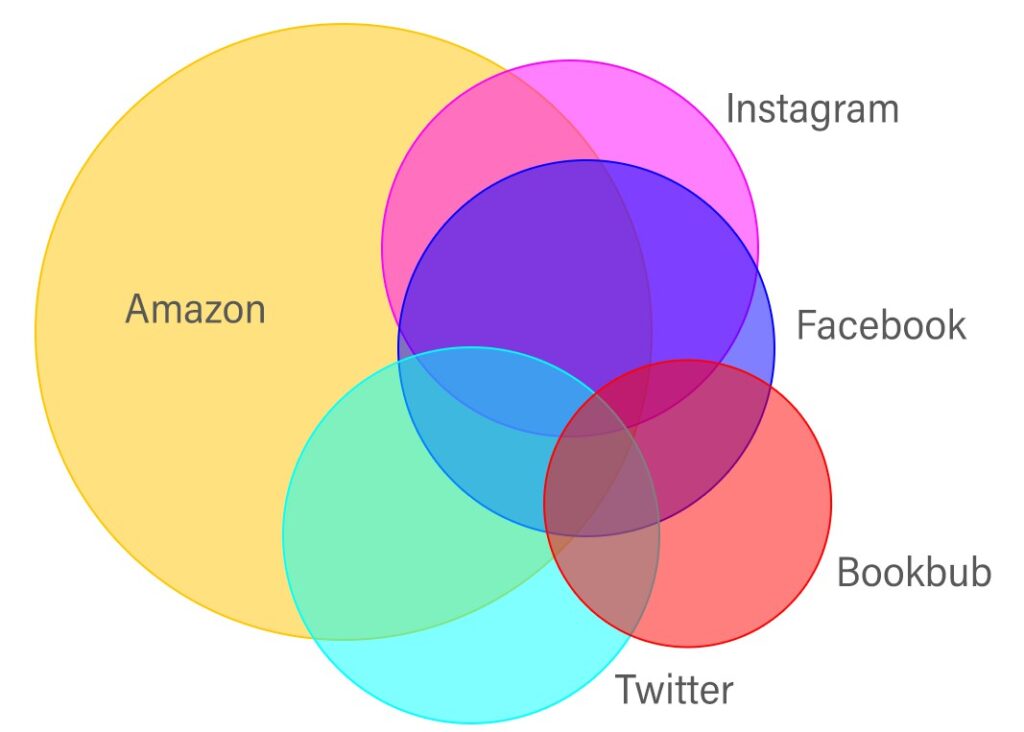
Having lots of different entry points adds more circles to your Venn diagram of potential readers. (Illustrative values only).
Marketing strategies such as paid ads, publicity appearances, newsletter swaps, social media campaigns, sales and discounts etc do one thing and one thing only: Drive people to your entry points.
Maximize the chances for these strategies to succeed by removing invisible barriers between the readers they bring in and those precious engagements.
Links between sites also improve search engine visibility, so having more interconnected entry points amplifies your web presence and makes you more visible.
DO THIS: Write a list of all your entry points. Could you add more?
-
Intuitive Navigation
The simplest way to make navigation within your web presence intuitive and simple, is to use your author website as your "hub". If every entry point funnels people to your website where they will find direct links to buy, sign up or share your content, you're covered.
But you can go further by making each part of your web presence link to ALL the other parts, creating a web with multiple paths. Having multiple ways to accomplish the same thing makes navigation more intuitive.
Avoid orphaning any of your entry points. For example, if your book page on Amazon connects to your Author Page, but your Author Page doesn't then clearly connect to your website/social media, it is a dead end. Readers trapped in your little Amazon loop may buy your book, but imagine if some of them also clicked through, signed up for your mailing list or shared your Facebook page with their friends.
Draw a map of your web presence:
- Put your website in the middle of the page as your "hub"
- Around it, list all the parts of your web presence.
- Draw arrows to show how readers can navigate between them. Look for gaps. Are there any parts with no links at all? Which parts only have links going one way? Would it be beneficial to make the link go both ways?
- Look at the chains of links between different parts. What is the shortest route? Could you create a shorter one?
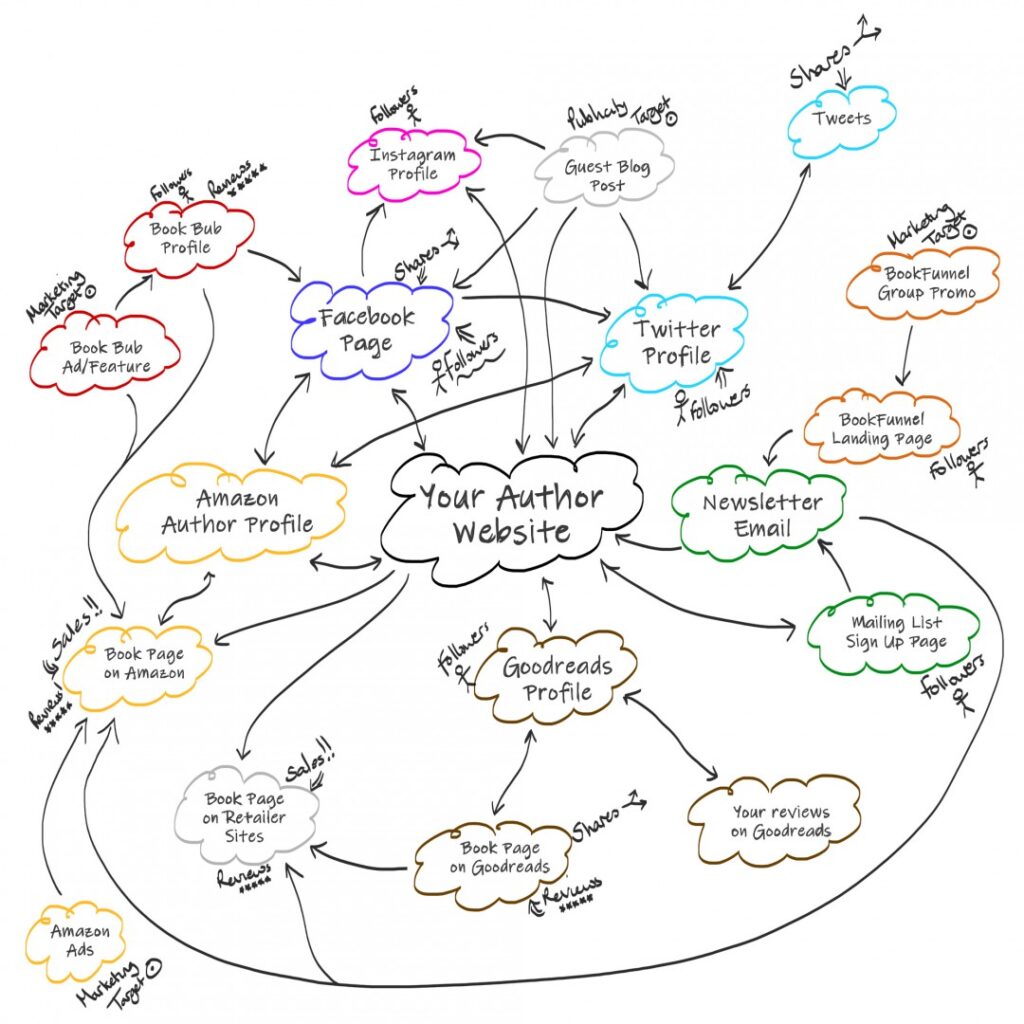
An example of a web presence map. Can you spot any opportunities to improve it?
-
Consistent Communication
What does this third thing have to do with the first two?
It's about trust and confidence.
On a well-designed website, like Amazon or Facebook it is usually very clear when you are EXITING that environment. You intuitively know which links and buttons will take you to another part of that site and which will navigate away. How? Because of branding and consistent design/language.
In contrast, imagine a time when you clicked on something you thought was a safe link within the site you were using, but it took you outside of it e.g. a spurious download link in a cleverly disguised advert. It made you wary, didn't it?
Inconsistency is at best frustrating and misleading, at worst scary and intimidating.
Your web presence is not a single site, and you cannot control the entire environment that the user finds themselves in, but you can use some of the same strategies used by web designers to make your users feel safe and confident.
Author Platform: A Consistent Web Presence
- Pick a color scheme for your website and extend this color scheme to every other place where you can control the design and appearance of your page.
- Use similar wording in your biographies/about pagesso it's always clear you are the same person. Make sure certain keywords/phrases always appear. A long bio should include all the information from your short bio.
- Use consistent header graphics,featuring your books or a logo. When you update it, make sure you update it everywhere at the same time.
- Use identical or at least consistent/similar avatar imagesso people can recognize you. This creates an immediate trust factor.
Making your web presence feel, as much as possible, like it was all designed by the same person makes it comfortingly familiar and recognizable as readers negotiate the different entry points to your author platform.
How To Get An Author Platform By Blogging
Source: https://selfpublishingadvice.org/author-platform/
Posted by: mendosapold1939.blogspot.com
0 Response to "How To Get An Author Platform By Blogging"
Post a Comment